

At a glance
- Capacity voltage and USB output voltage are different specifications.
- A Wh calculation does not establish permission to carry or use a battery.
- Output compatibility and tested runtime still need separate checks.
Use the exact battery’s manufacturer-labelled watt-hours when preparing a travel enquiry. If you need to calculate the value, use the voltage associated with its stated capacity. Do not multiply a power bank’s mAh by an arbitrary USB output voltage and assume the result describes its stored energy.
CASA gives the formula Wh = V × Ah, or V × mAh ÷ 1000 (opens in a new tab). This is a way to understand the label. The airline still decides whether the exact battery is accepted under its current conditions.
Which voltage belongs in the calculation?
A power bank can store energy at one nominal cell voltage and provide several output voltages through conversion electronics. The capacity figure must be paired with the voltage to which it refers. If the label does not make that relationship clear, ask the manufacturer for the official Wh rating and specification sheet.
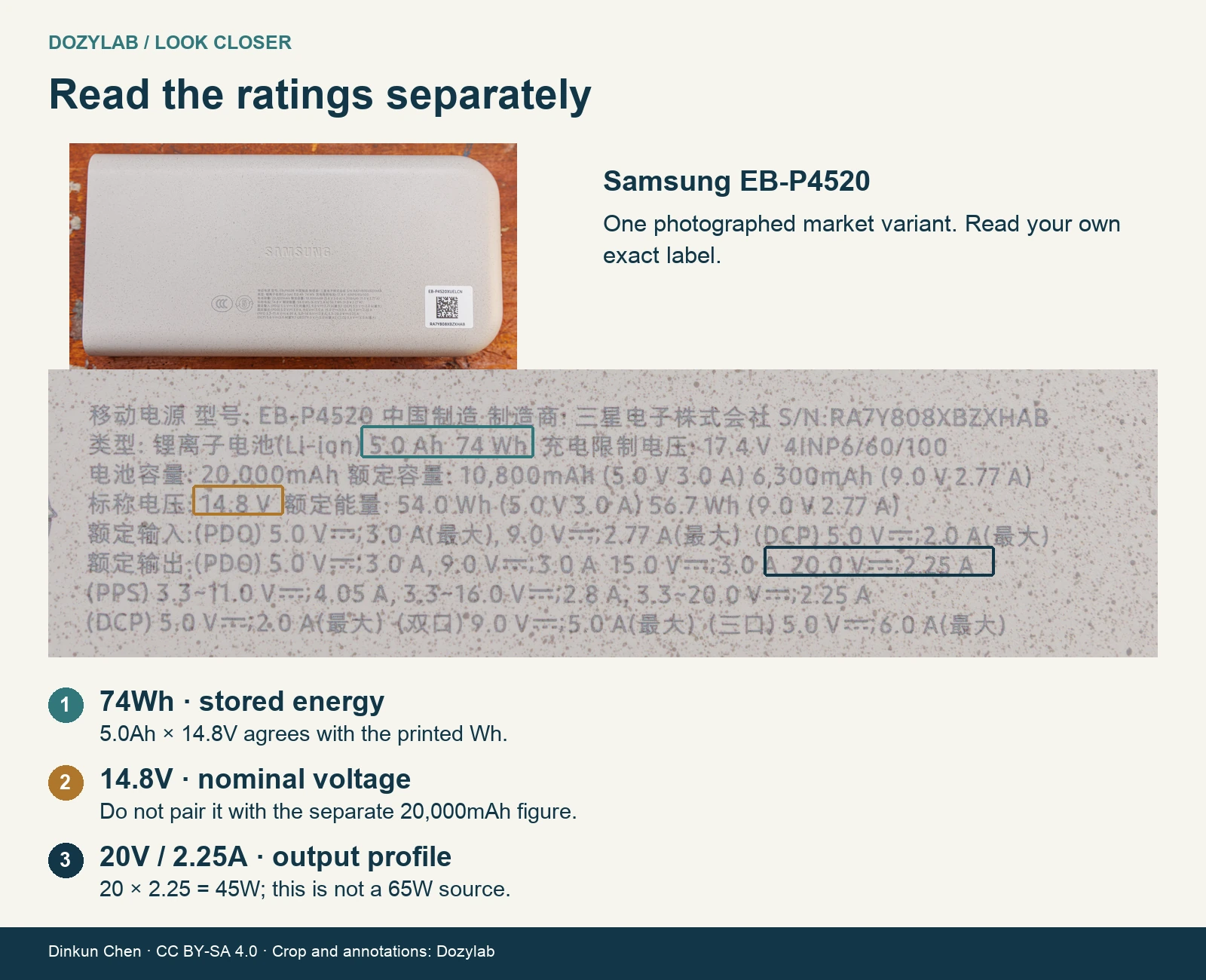
The photographed Samsung EB-P4520 label below makes the distinction concrete. It states 5.0Ah / 74Wh and a nominal voltage of 14.8V, while listing 20,000mAh separately. The matching pair gives 5.0 × 14.8 = 74Wh. Multiplying the separate 20,000mAh figure by 14.8V would incorrectly give 296Wh. Use the stated Wh or a clearly matched pair, and ask the manufacturer if the basis is unclear. This is one Chinese-market label variant, not a universal label format.
| Specification | What it describes | What it does not prove |
|---|---|---|
| Wh | Rated stored energy | A guaranteed number of CPAP hours |
| Output volts and amps | The source profile offered at a port | How much energy is stored |
| Charging input | How the bank can be replenished | That its output remains uninterrupted while charging |
 (opens in a new tab)
- The photographed label states 5.0Ah and 74Wh, with a nominal voltage of 14.8V. The matching calculation is 5.0Ah × 14.8V = 74Wh.
- The separate 20,000mAh capacity figure must not be multiplied by 14.8V. That would give 296Wh by combining figures on different bases. Use the manufacturer’s stated Wh or a clearly matched voltage/capacity pair.
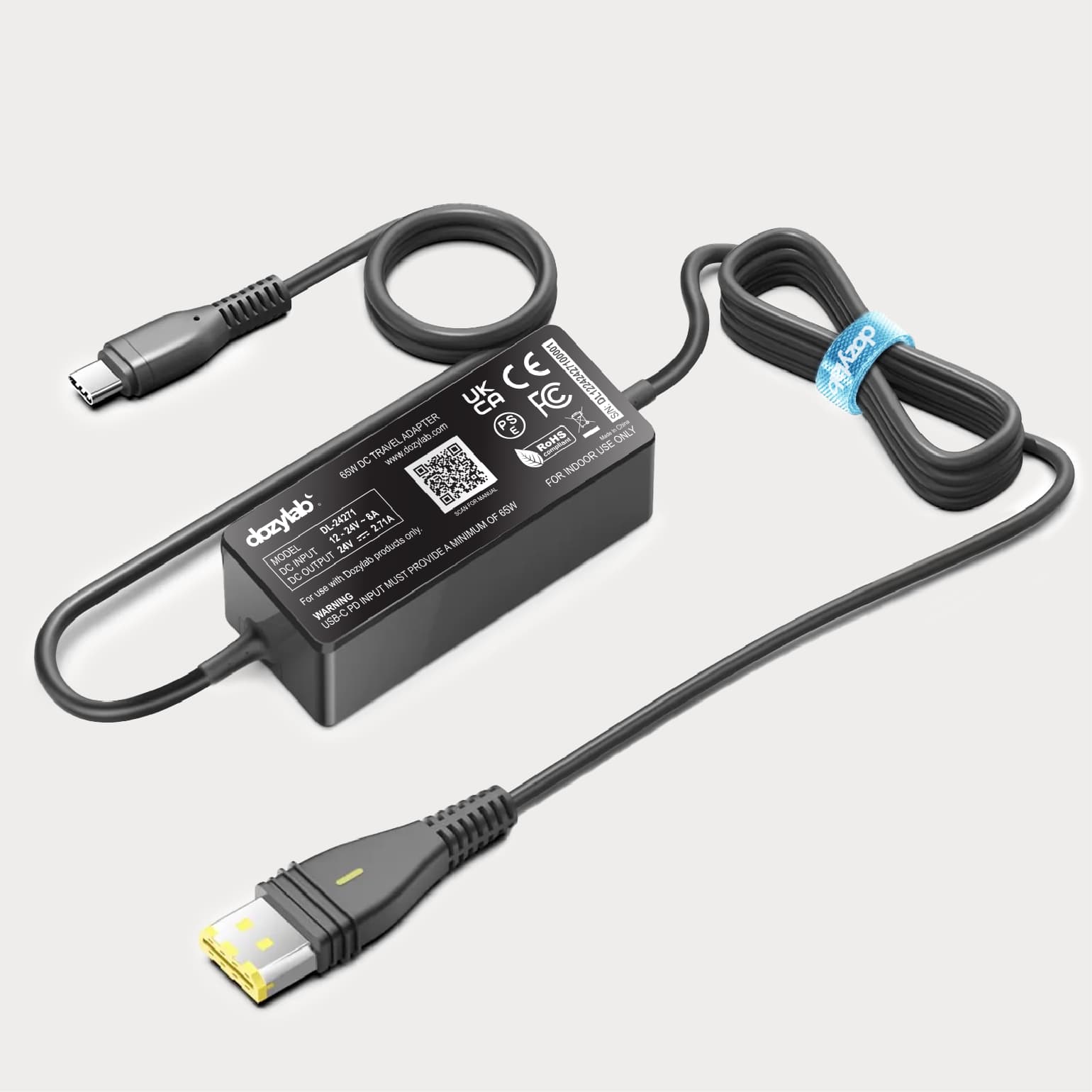
- Its printed 20V / 2.25A PDO output corresponds to 45W. That is below the 20V / 3.25A source profile required by the Dozylab cable. This is a label-reading example, not a compatible CPAP battery recommendation.
This is one Chinese-market label variant. It establishes neither tested runtime nor current carrier acceptance.
What should I send to the airline?
Provide the exact model, chemistry, Wh rating and a clear photo of the label, plus the manufacturer specification if requested. Explain whether it is a general power bank or a dedicated medical-device battery and how you intend to use it. Do not remove, cover or replace the original rating label.
Ask about carriage, storage, charging and use on board. General regulator guidance and carrier conditions can differ in scope or become outdated. A self-calculated value does not guarantee that an unlabelled battery will be accepted.
Does a low wh rating mean it will run my CPAP?
No. Output compatibility is separate. For the Dozylab cable with a compatible AirMini or AirSense 11, the actual USB-C PD port must provide 20V / 3.25A (65W). A bank can have a plausible energy capacity but lack that output profile. Use the compatibility guide and read the port specification.
For runtime, see our power-consumption guide. Conversion losses, operating conditions and the complete setup affect how much stored energy becomes useful treatment time. A capacity calculation is not an overnight test.
What if the label is worn or unclear?
Contact the manufacturer and carrier before travel. Keep documentation that clearly matches the device, but do not assume a screenshot can overcome every labelling requirement. If the battery shows damage, swelling or abnormal heating, stop using or charging it and follow the maker’s safety and disposal guidance.
CASA advises keeping spare lithium batteries and power banks in the cabin with terminals protected (opens in a new tab). Recheck current conditions for every flight in the itinerary. Our security guide and airline comparison cover the broader journey, without turning a label calculation into a promise of airline approval.
Frequently asked questions
Can I multiply mAh by the 20V USB output?
Only if that capacity is explicitly specified at 20V. Usually you need the nominal voltage associated with the rated capacity; ask the manufacturer if unclear.
Does a 74Wh battery guarantee a full night?
No. Capacity, output compatibility and runtime are different checks. Test the complete setup with reserve capacity.
Sources
Sources consulted 15 November 2026. This is an editorial research date, not a clinical review. Policies, device instructions and evidence can change; check current guidance for your circumstances.
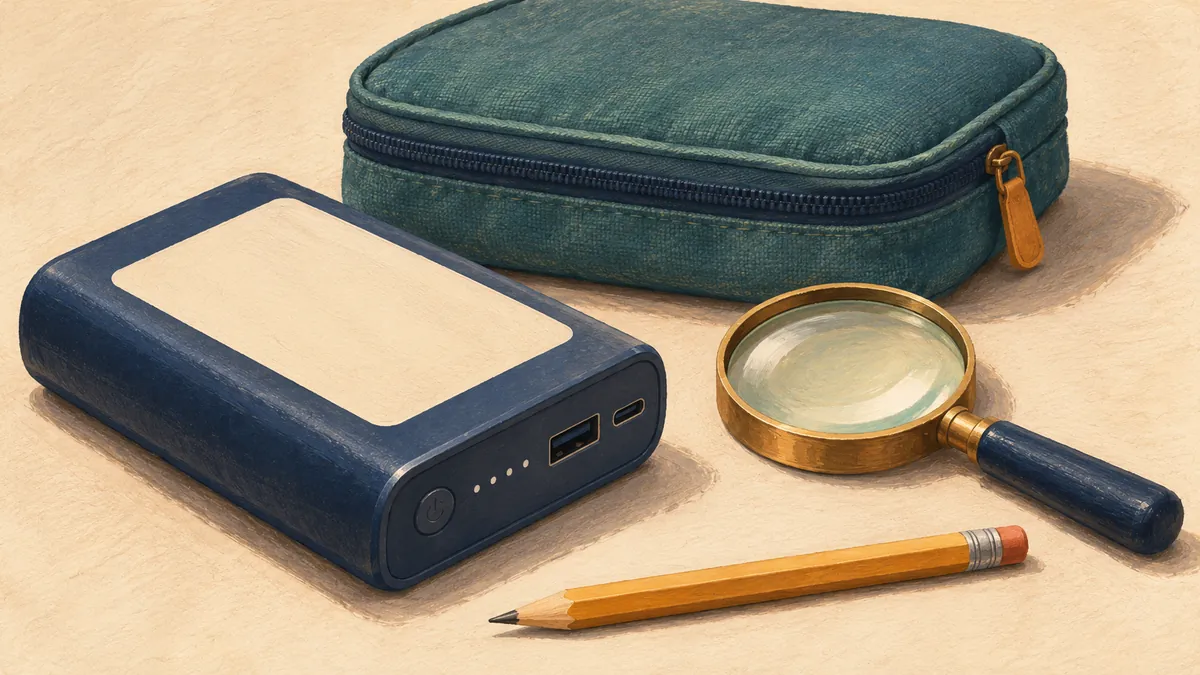
The cover is an original editorial illustration. Equipment is illustrative; the image is not evidence of product testing or a patient outcome.
- CASA Pack Right: lithium batteries (opens in a new tab): Battery labelling arithmetic, terminal protection and cabin packing. Check current airline restrictions.
- USB-IF: USB Power Delivery developer presentation (opens in a new tab): Assured-capacity and shared-capacity ports; the exact charger manual remains necessary.
General information, not medical advice. Airline, cruise line and security rules change, so check the current policy before you travel, and talk to your doctor or sleep clinic about your own therapy.
About the author
Ryan
Co-founder, Dozylab
Ryan co-founded Dozylab with Benjamin. He lives with severe sleep apnoea, travels with his own CPAP, and writes our travel guides from the official airline, cruise line and regulator sources linked in each one.
Our story