
Understanding your CPAP machine's power consumption isn't just useful information — it's the difference between picking a power bank that will last the night and one that runs out at 3am. This guide explains the key concepts and gives you real numbers to work with.
The Units: Watts, Amps and Watt-Hours
Three units come up whenever you're talking about CPAP power:
- Watts (W) — the rate at which your machine uses power right now. Think of this as the "speed" of power consumption.
- Amps (A) — the current flowing through the cable. At a given voltage, amps × voltage = watts.
- Watt-hours (Wh) — the total amount of energy a battery can store, or the total energy consumed over time. A machine drawing 30W for 8 hours consumes 240Wh. A power bank rated at 200Wh can theoretically supply 30W for just under 7 hours (minus conversion losses).
When choosing a power bank, Wh is the number that matters. When checking whether a power bank can supply your CPAP, W (specifically the 20V PD output wattage) is the number that matters.
How Much Power Does Your CPAP Actually Use?
Power consumption varies significantly based on your therapy settings — particularly whether you're using the humidifier and heated tube. Here are approximate figures for common ResMed machines:
ResMed AirSense 11
- No humidifier, no heated tube: approximately 20–35W
- Humidifier at mid-level setting: approximately 35–50W
- Humidifier at maximum + heated tube: approximately 55–70W
ResMed AirMini
- No humidification (or with HumidX): approximately 18–28W
ResMed AirSense 10 (older model)
- Without humidifier: approximately 25–35W
- With humidifier: approximately 40–55W
These are approximate ranges — your actual usage depends on your prescribed pressure, the ambient temperature, and your specific settings. Our CPAP Power Calculator lets you enter your exact machine and settings to get a more accurate estimate.
Calculating Battery Runtime
The formula is straightforward:
Runtime (hours) = Power bank capacity (Wh) ÷ Machine power draw (W) × Efficiency factor
The efficiency factor accounts for the conversion losses in the power bank and cable circuitry — typically around 85% (0.85) for good quality power banks.
Example: A 100Wh power bank, AirSense 11 running at 30W (no humidifier):
100 ÷ 30 × 0.85 = approximately 2.8 hours
Example: A 150Wh power bank, AirSense 11 running at 45W (humidifier at mid-level):
150 ÷ 45 × 0.85 = approximately 2.8 hours
Example: A 150Wh power bank, AirSense 11 running at 28W (no humidifier, dialled-back pressure):
150 ÷ 28 × 0.85 = approximately 4.5 hours
Why 20V Is Required
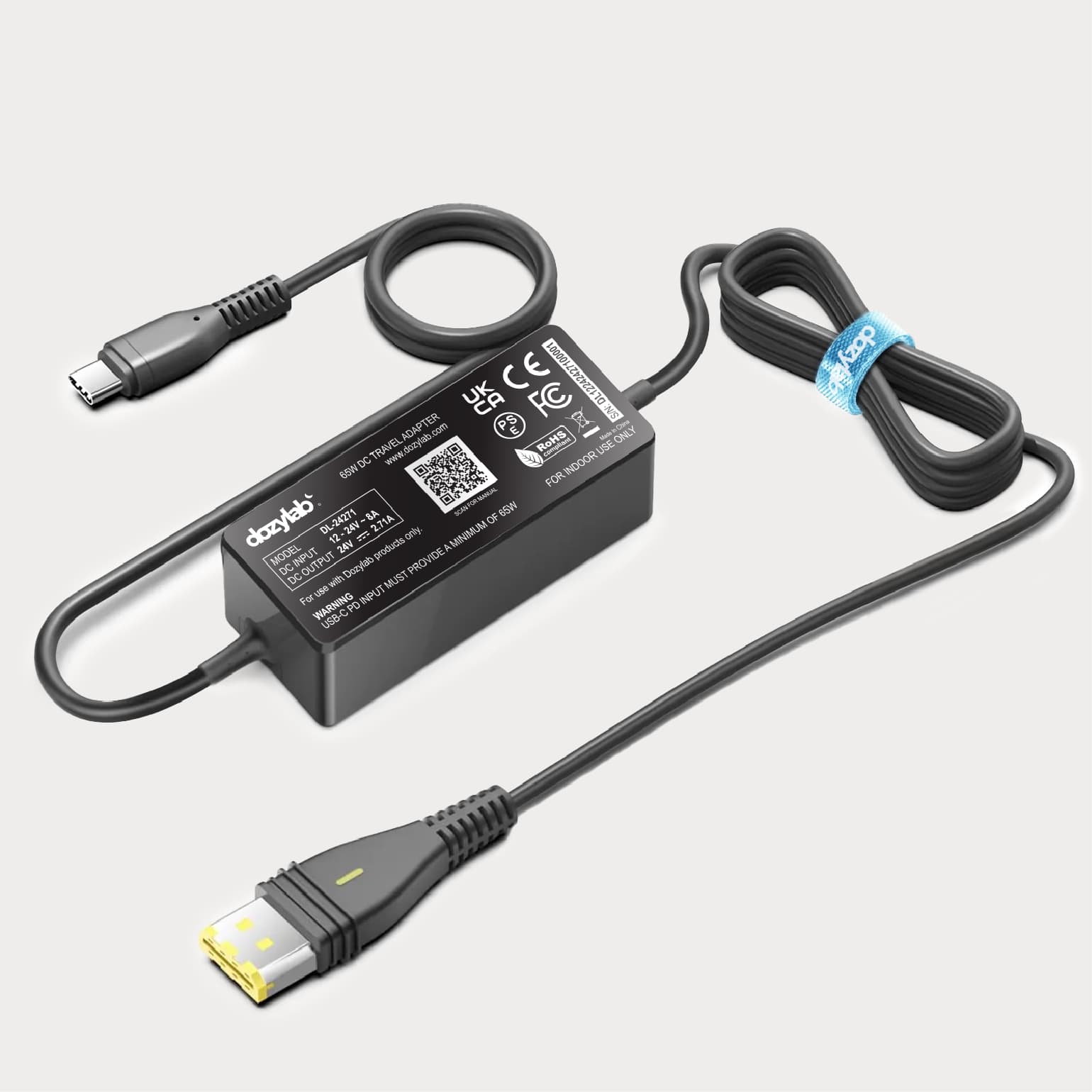
The AirSense 11 and AirMini both run internally at 24V. When using a USB-C power bank, the cable needs to step the voltage up from the power bank's output to the machine's requirement. This is only possible if the power bank can output 20V via USB-C Power Delivery (PD) — the highest standard PD voltage — which the cable's onboard chip then converts to 24V.
Power banks that only output 5V, 9V or 12V won't power your CPAP. You need to specifically look for a 20V/3.25A (65W PD) output in the power bank's spec sheet. The Dozylab USB-C Travel Cable handles the voltage conversion internally — you just need the right power bank to feed it.
The Single Best Way to Extend Your Battery Life
Turn off the heated humidifier. It's responsible for 20–40W of additional consumption — often as much as the motor itself. Most travellers find that sleeping without humidification for one night is tolerable, particularly in cooler climates. If complete dryness is uncomfortable, try saline nasal spray before bed or a HumidX passive filter if you have an AirMini.
Disabling the humidifier can effectively double your battery runtime. That's the difference between a power bank that gets you through half the night and one that sees you to morning.