Travelling with Medical Equipment: A Complete Guide
Millions of Australians travel each year with CPAP machines, insulin pumps, portable oxygen concentrators, and other essential medical equipment. And millions of them face the same anxieties: Will security stop me? Will I be charged extra? What if my equipment is damaged in the hold?
The good news: travelling with medical equipment is well-supported by most major airlines and airport security agencies. The rules are consistent, the exemptions are real, and a little preparation goes a long way. This guide covers everything — from airline baggage policies to security procedures to how to label your bag so it's treated with care at every checkpoint.
What Counts as Medical Equipment?
For airline purposes, “medical equipment” generally refers to devices that are medically necessary for the passenger during the flight or journey — not just health products. Common examples include:
- CPAP and BiPAP machines (sleep apnoea therapy)
- Insulin pumps and continuous glucose monitors (CGMs)
- Portable oxygen concentrators (POCs)
- Nebulisers
- Implanted cardiac devices (pacemakers, ICDs)
- Orthopaedic braces and prosthetics
- Sharps containers (for insulin users)
In most cases, you'll need to carry a doctor's letter or prescription confirming medical necessity, especially for devices that go through security screening. More on documentation below.
Airline Baggage Policies: The Free Medical Equipment Allowance
This is where most travellers are pleasantly surprised. The majority of major airlines allow medical equipment as an additional item outside your standard carry-on and checked baggage allowance — meaning it doesn't count against your luggage limit.
Airlines that explicitly allow free carriage of medical equipment (as of 2026) include:
- Qantas — medical equipment allowed as an additional carry-on at no charge
- Virgin Australia — medical and mobility devices exempt from baggage limits
- Emirates — medical equipment carried free in addition to standard allowance
- Singapore Airlines — life-supporting equipment permitted without charge
- Air New Zealand — CPAP devices and medical equipment travel free
- Cathay Pacific — medical equipment not counted in carry-on allowance
- British Airways — medical and mobility equipment exempt from fees
- Thai Airways, Etihad, Air France, KLM — all offer medical equipment exemptions
Always confirm before you fly
Airline policies vary and change. Always check your specific carrier's medical equipment policy before travel, and consider calling ahead if you're carrying bulky or powered equipment. Policies also differ between carry-on and checked baggage, and between domestic and international routes.
The Key Condition: Your Equipment Must Be Identifiable as Medical
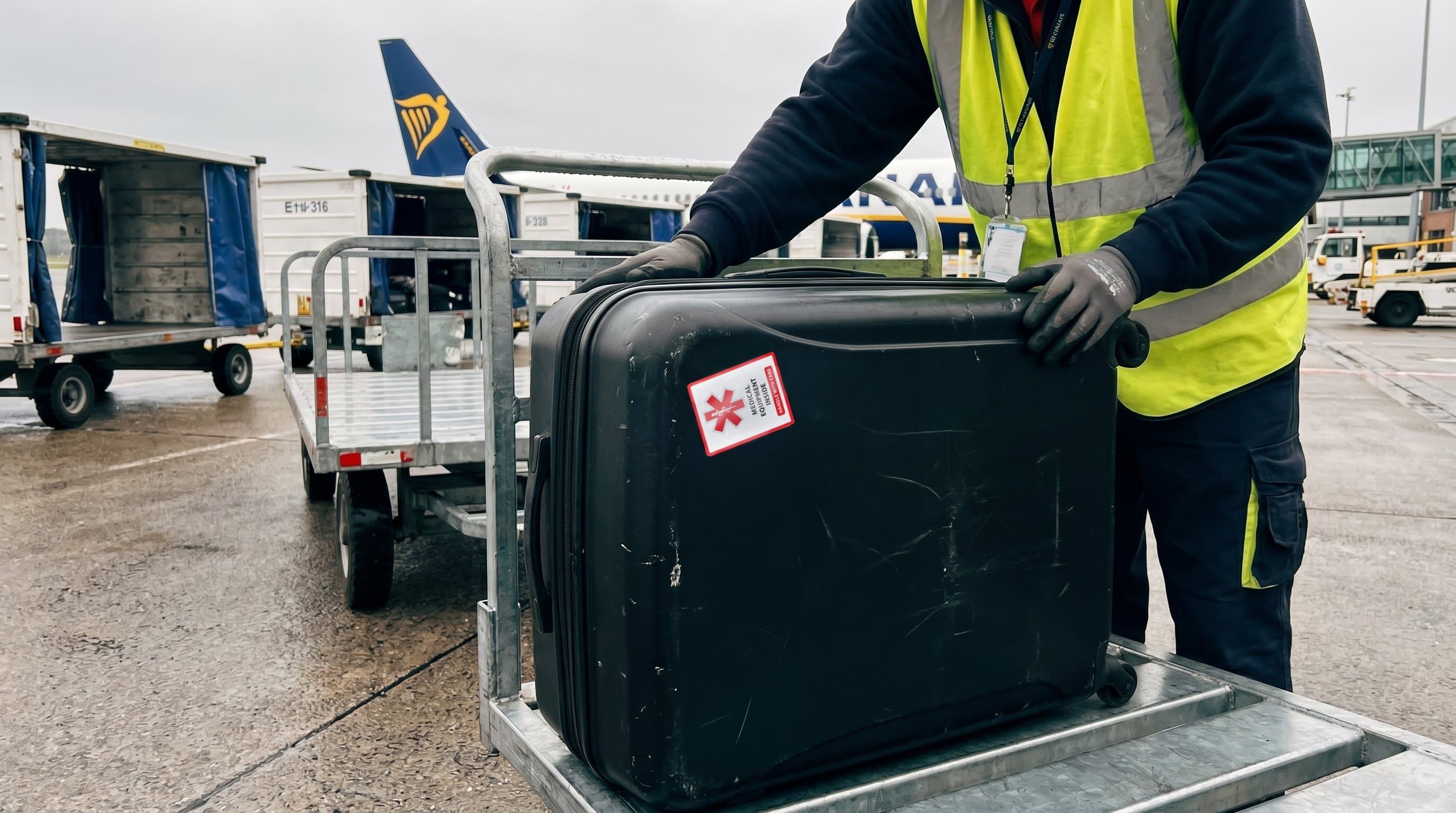
Almost universally, the free medical equipment allowance applies only if the equipment is clearly identified as medical. Airlines and check-in staff need to recognise that what you're carrying is a medical device, not just an extra bag of electronics or luggage.
This is where clear, professional labelling matters — not as a bureaucratic formality, but as a practical signal to every person who handles your bag. A bag that looks like medical equipment gets treated like medical equipment.
Label It Clearly
Medical Equipment Identification Sticker
A permanent vinyl sticker bearing the internationally recognised medical symbol — applied directly to your equipment bag or case. UV-resistant, waterproof, and dishwasher safe. Sized to be visible at a glance without being obtrusive.
View the Medical Equipment StickerAirport Security: What to Expect
Security screening is the part most travellers worry about. The reality is usually straightforward — but knowing what to expect means you won't be caught off guard.
CPAP and Powered Medical Devices
CPAP machines and similar powered devices are typically treated as medical equipment by airport security — but they will be screened. In most airports, including Australian and most international airports, CPAP machines must be removed from their bag and placed in a tray for X-ray screening separately, similar to laptops.
The TSA (United States) explicitly lists CPAP machines as medical devices that may require additional screening. CATSA (Canada), the Australian Border Force, and most European security agencies follow similar protocols.
What to Tell the Officer
When you reach the screening point, you don't need to make a speech — just a brief, clear statement:
“I have a CPAP machine [or insulin pump / portable oxygen concentrator] — it's medical equipment. Do you need me to remove it separately?”
This signals that you know the process, you're cooperative, and that the equipment is medical rather than suspicious. In most cases, the officer will direct you from there.
Insulin Pumps and CGMs
Implanted or body-worn devices like insulin pumps and CGMs cannot go through X-ray scanners. You'll need to inform the security officer before you reach the scanner, ask for a pat-down instead, and carry a medical device identification card (most device manufacturers provide these). Your doctor can also provide a letter if needed.
Liquids — Insulin, Eye Drops, and Medical Solutions
Medical liquids are generally exempt from the standard 100ml carry-on liquid restriction. Insulin, liquid medication, sterile water for CPAP humidifiers, and similar medical liquids can typically be carried in quantities exceeding 100ml — but you'll need to declare them at security and may be asked to present a prescription or doctor's letter.
Documentation: What to Carry
The level of documentation required varies by country, airline, and device. For most routine travel with common equipment like CPAP machines, you won't be asked for documentation at all. But having it ready prevents problems if you are.
Recommended Documentation
- Doctor's letter or prescription — confirming the medical necessity of the device, ideally on letterhead with your doctor's contact details. One page is enough.
- Device documentation — the user manual or regulatory documents showing the device is CE/TGA/FDA approved. Most manufacturers include these.
- Airline confirmation — if you've pre-notified the airline (recommended for oxygen concentrators), carry the written confirmation.
- Medical device ID card — for implanted devices like pacemakers and insulin pumps, carry the manufacturer-issued card that certifies the implant.
For Portable Oxygen Concentrators (POCs)
POCs require advance approval from the airline — typically at least 48 hours before the flight. Not all POC models are approved for in-flight use (they must appear on the FAA's approved list). Your respiratory specialist should be able to advise which models are approved and provide the required documentation.
Checking In Equipment: Hold vs Carry-On
For most medical equipment, carry-on is strongly preferred over checked baggage. Reasons:
- Checked bags can be lost, delayed, or roughly handled
- Temperature and pressure variations in the hold can affect some equipment
- Batteries (including lithium batteries) are often restricted from checked baggage entirely
- You may need the equipment during the flight (oxygen, insulin)
If you must check equipment, label it clearly on the outside, pad it well inside a hard case, and never check lithium batteries — these must travel in the cabin with you.
How to Label Your Equipment Bag
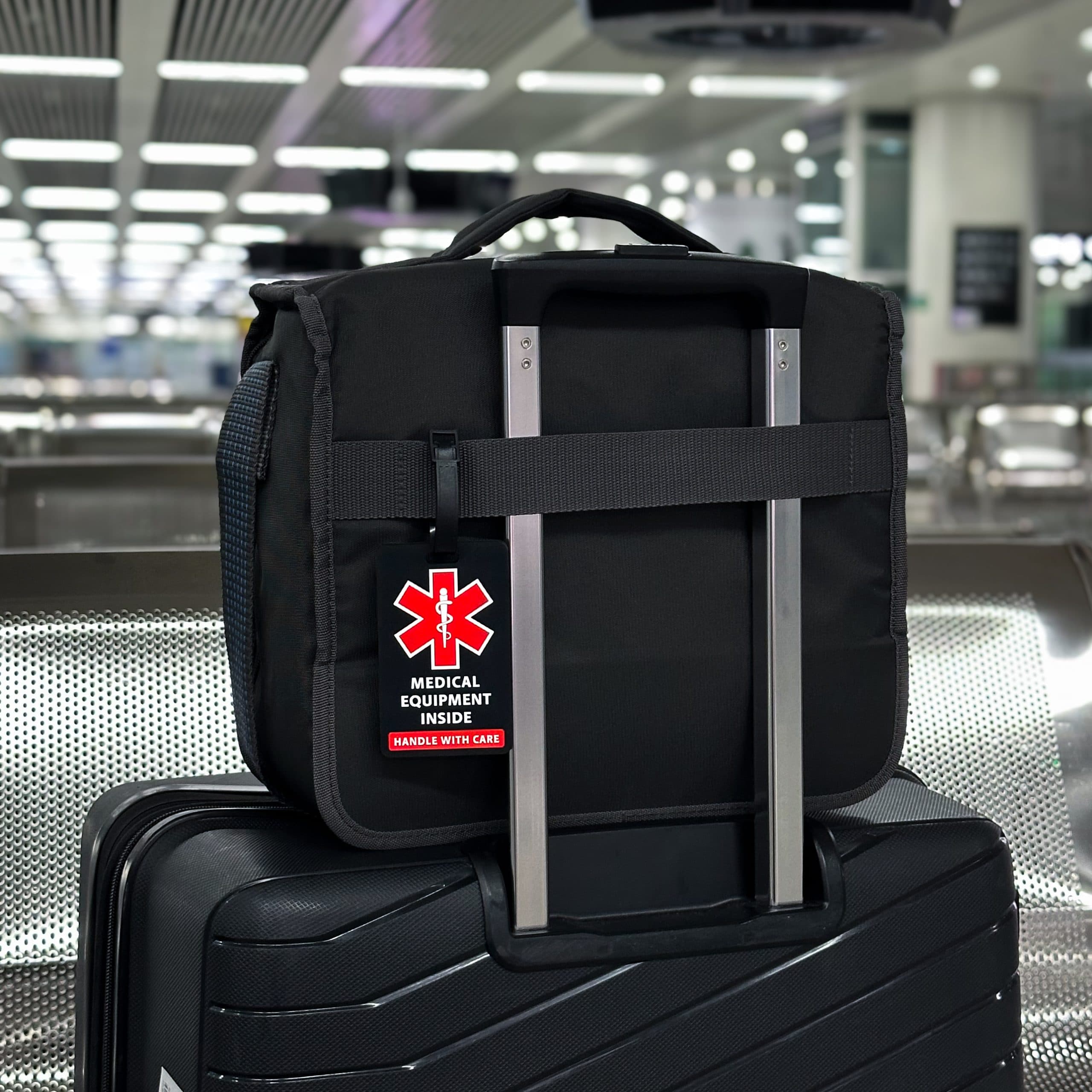
Professional, clear labelling serves two practical functions: it triggers the medical equipment exemption at check-in, and it signals to every handler — from the baggage conveyor to the hold — that the contents require care.
The internationally recognised symbol for medical equipment is the Rod of Asclepius — a single snake coiled around a staff. It's used by the WHO, the Australian Medical Association, and medical institutions in virtually every country except the United States (which has historically confused it with the caduceus, a commercial symbol).
For labelling equipment bags and cases, there are two main options:
- Luggage tag — a reusable tag attached to the handle, with your contact details on the back. Visible at check-in and easily removed between trips.
- Identification sticker — permanently applied to the case itself. Always present, can't fall off, and visible even when the tag is removed.
Also available
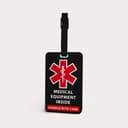
Medical Equipment Luggage Tag
Flexible PVC rubber with glow-in-the-dark elements. Includes your contact details on the back — name, number, email. The correct Rod of Asclepius symbol on the front. Attaches with a stainless steel loop.
View the Luggage TagA Quick Pre-Travel Checklist
- Confirm your airline's medical equipment policy (call or check online)
- Carry a doctor's letter or prescription
- Label your equipment bag clearly with the correct medical symbol
- Remove CPAP from its bag at security — treat it like a laptop
- Keep lithium batteries in the cabin, not in checked luggage
- Pre-notify the airline if you need in-flight oxygen (at least 48 hours ahead)
- Pack a spare power adapter or travel cable in case yours is misplaced
- Carry sterile water if your CPAP uses a humidifier (declare at security)
The Bottom Line
Travelling with medical equipment is not the ordeal many people expect. Airlines have built-in exemptions for it, security agencies are trained to handle it, and the process is well-established. The main variables are preparation — having the right documentation, the right labelling, and a clear understanding of what to expect.
Most of the friction comes from uncertainty, not from actual policy. Once you've done it once, it becomes routine.