
Rod of Asclepius vs Caduceus: Why the Medical Symbol on Your Equipment Matters
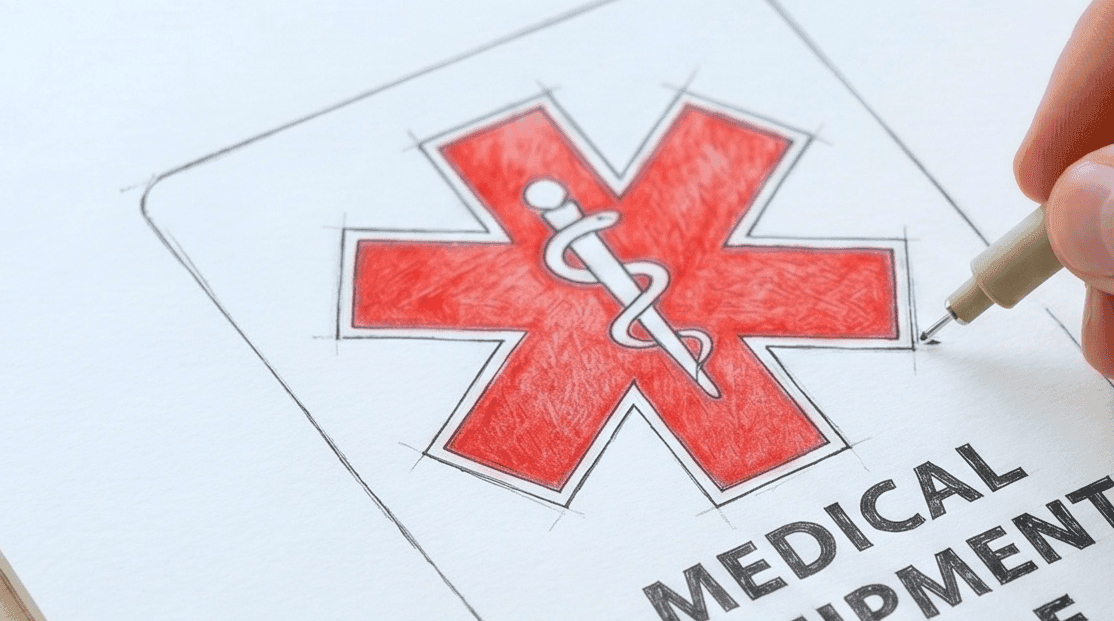
Take a look at the symbol on your medical equipment tag, your prescription bottle, or the logo of your local hospital. Is it a single snake coiled around a rough staff? Or two snakes with wings at the top? The difference might seem trivial — but in medicine, and especially in international travel with medical equipment, symbol accuracy matters more than most people realise.
The two symbols are confused so routinely that the majority of healthcare logos — particularly in the United States — get it wrong. This article explains what each symbol is, where the confusion came from, why it persists, and why it actually matters when your medical equipment crosses a border.

Rod of Asclepius
1 snake · No wings · Plain staff
✓ The correct medical symbol
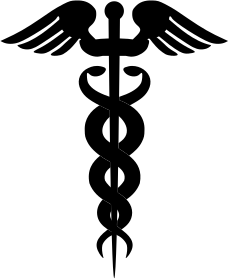
Caduceus
2 snakes · Wings at top · Winged staff
✗ Symbol of commerce — often misused
The Rod of Asclepius: The True Symbol of Medicine
The Rod of Asclepius gets its name from Asclepius — the ancient Greek god of medicine and healing. In Greek mythology, Asclepius was the son of Apollo and a mortal woman named Coronis. He trained under the centaur Chiron and became so skilled in the healing arts that he could reportedly raise the dead. Zeus, worried that Asclepius would upset the natural order, eventually struck him down with a thunderbolt — though he was later elevated to godhood in recognition of his contributions to humanity.
His symbol — a rough walking staff with a single snake coiled around it — is thought to derive from ancient healing practices. Snakes in the ancient world represented renewal and rebirth (they shed their skin), wisdom, and the paradox of both poison and cure. The staff itself suggested a travelling healer, carrying his art from place to place. Together, the image became a universal shorthand for medicine.
The symbol was adopted by the ancient Greeks and Romans, carried through medieval European medicine, and eventually became the emblem of virtually every major medical institution in the world — including the World Health Organization, the British Medical Association, the Australian Medical Association, and most national medical councils globally.
The Caduceus: Beautiful, Wrong, and Surprisingly Widespread
The caduceus — two snakes intertwined around a winged staff — is an entirely different symbol with an entirely different meaning.
It belongs to Hermes (called Mercury by the Romans), the messenger of the Greek gods. Hermes was the patron deity of travellers, merchants, eloquence — and, notably, thieves and liars. He carried the caduceus as his staff of office, and the two snakes are said to represent balance and negotiation, not healing. The wings at the top signify speed and his role as a messenger.
Historically, the caduceus has represented commerce, trade, and diplomacy — not medicine. It appears in the iconography of printers, alchemists, and merchants throughout history. Even in modern usage, it appears on the logos of the US Department of Commerce and various financial institutions.
“The caduceus as a medical symbol is practically unknown outside of the United States. Its use in American medical contexts represents a historical error that has calcified into convention.”
— Stuart L. Tyson, writing in the Bulletin of the New York Academy of Medicine, 1932
How America Got It Backwards: The 1902 Mistake That Stuck
The widespread misuse of the caduceus in American medicine traces back to a single administrative decision made in 1902. That year, the US Army Medical Corps adopted the caduceus — likely due to a confusion between the two symbols, or possibly a deliberate choice to emphasise the Army Medical Corps's non-combatant, logistics-focused role (the caduceus, as a symbol of Hermes, carried diplomatic immunity connotations).
The decision was controversial from the start. Scholars and medical professionals pointed out the error, but the symbol was already in institutional use. Over the following decades, American commercial healthcare companies followed the military lead, and the caduceus slowly infiltrated hospital logos, pharmaceutical branding, and medical education iconography across the country.
A landmark 1992 study published in the Journal of the American Medical Association (JAMA) quantified just how far the confusion had spread: 62% of US commercial healthcare organisations used the caduceus, versus only 37% of professional and scientific medical bodies. The pattern was clear — commercial entities had adopted the commercial symbol; professional medical science had maintained the correct one.
Who Gets It Right?
Outside of the United States, the Rod of Asclepius is nearly universal in medical symbolism. The World Health Organization, the International Red Cross (in the context of medical identity symbols), the Royal Australasian College of Physicians, the British Medical Association, and the vast majority of national medical councils worldwide use the Rod of Asclepius exclusively.
Within the US, professional and scientific medical organisations tend to get it right. The American Medical Association, the US Navy Bureau of Medicine and Surgery (which corrected the Army's error), and most US medical schools use the Rod of Asclepius. The caduceus persists mainly in commercial healthcare contexts — insurance companies, pharmaceutical firms, and general-purpose “medical” branding.
Symbol Knowledge Check
Can you tell them apart?
How many snakes does the Rod of Asclepius have?
Why It Matters on Your Medical Equipment
For most people, the symbol on a medical logo is purely aesthetic — a piece of design trivia. But for people who travel internationally with medical equipment, the symbol on their identification tags and documentation carries practical weight.
Airport Security and Customs
When you carry a CPAP machine, insulin pump, portable oxygen concentrator, or other medical device through international airports, you're relying on airport security and customs officers to recognise it as medical equipment rather than undeclared electronics or a potential security concern. In that context, every visual cue helps.
The Rod of Asclepius is the internationally recognised medical symbol. It appears in the IATA Medical Manual, on WHO publications, and in the visual language of airport medical facilities worldwide. A medical equipment identification tag bearing the correct symbol communicates clearly to trained staff: this is healthcare equipment, not luggage content to be scrutinised.
The caduceus, by contrast, is often unrecognised outside of North America. In Asia, Europe, the Middle East, and South America — where the Rod of Asclepius is the standard — a caduceus may simply not register as a medical symbol at all.
Emergency Medical Situations Abroad
If you have a medical emergency while travelling — particularly in a country whose language you don't speak — first responders and emergency medical staff will look for visual cues about your medical status. A clearly labelled medical equipment tag bearing the internationally correct symbol is part of the visual vocabulary that trained medical professionals understand everywhere from Tokyo to São Paulo to Nairobi.
This isn't hypothetical. International travellers who use sleep apnoea equipment, carry insulin, or manage other chronic conditions are frequently advised by travel health specialists to carry clear, internationally legible medical identification. The symbol is part of that legibility.
The Credibility Signal
There's a subtler point, too. A medical equipment tag that uses the correct symbol signals that the manufacturer understands medical convention, has done their research, and cares about accuracy. It's a credibility signal — the same reason a hospital that uses the Rod of Asclepius on its signage reads as more professionally informed than one that defaulted to the commercial caduceus.
Dozylab Gets It Right
The Medical Equipment Luggage Tag
Our luggage tag uses the Rod of Asclepius — one snake, no wings — the internationally recognised medical symbol. It's laser-engraved on aluminium, glows in the dark, and is sized to the IATA standard for medical equipment identification. Because accuracy matters, especially when you're crossing borders with equipment you depend on.
View the Medical TagA Quick Reference: Telling Them Apart at a Glance
The next time you see a medical symbol, here's all you need to remember:
- Rod of Asclepius: One snake, no wings, plain staff. Named after the Greek god of medicine. Used by the WHO, most national medical bodies, and professional healthcare organisations worldwide.
- Caduceus: Two snakes, wings at the top, often more decorative. Belongs to Hermes/Mercury, the messenger god. Represents commerce. Common in US commercial healthcare, but not the international medical standard.
The confusion between these two symbols has persisted for over a century, and it's unlikely to disappear entirely — the caduceus is simply too entrenched in American commercial healthcare. But for those who produce medical equipment, design medical identifiers, or advise patients who travel with medical devices, the distinction matters.
Accuracy is not pedantry. In medicine, it's the point.