The first time you travel with a CPAP machine, it takes some figuring out. By the fifth time, it's automatic — you have a system that fits in a specific pouch, goes in a specific spot in your bag, and comes out in a specific order at security. This guide is about getting to that point faster.
Always Carry-On: Never Check Your CPAP
This is the single most important rule: your CPAP machine travels in your carry-on bag, always. Not because of airline rules (though those also support this), but because:
- Checked luggage gets lost, delayed, and mishandled. Arriving at your destination without your CPAP machine is a medical inconvenience, not just a luggage inconvenience.
- Hold conditions (temperature, pressure fluctuations) are not ideal for sensitive electronics.
- As medical equipment, your CPAP is explicitly permitted as an additional carry-on item on most airlines at no charge. There's no benefit to checking it.
If your carry-on situation is genuinely tight, consider what you can move to checked luggage instead of the CPAP. Clothes can be replaced. Your CPAP can't be, at 11pm in an unfamiliar city.
The Dedicated CPAP Pouch
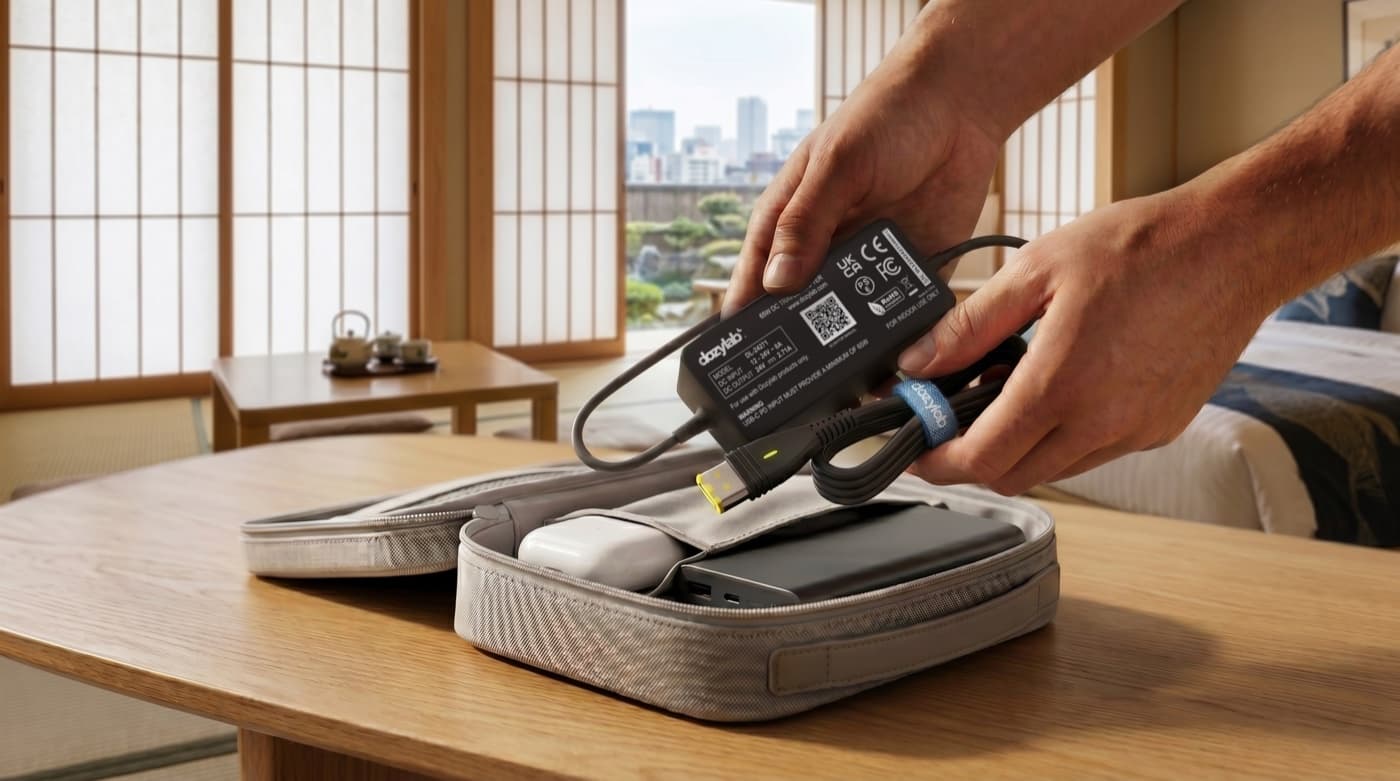
The most useful organisational habit for CPAP travel is keeping all your accessories in a single dedicated pouch. The pouch stays assembled between trips — you pack it once, and from then on it's just a matter of grabbing it. Nothing gets forgotten because everything lives in the same place.
A small to medium toiletry bag or cable organiser pouch works well. What goes in it:
- Power cable (the Dozylab USB-C Travel Cable or your standard ResMed power supply)
- USB-C wall charger (if using the cable method)
- Universal plug adapter (for international travel)
- Spare filter
- Spare mask cushion
- CPAP wipes (travel pack)
- Cable organisers
- Physician's letter (for international travel)
The machine itself and the mask stay separate — the machine in its case, the mask in a breathable bag — but the pouch contains everything else. Setting up at your destination is: take out machine, take out mask, take out pouch, plug in. Done.
What You Can Leave at Home
If you're using the USB-C cable with a power bank, you don't need to bring the standard ResMed power supply. It's the heaviest single item in a typical CPAP travel kit and the one that takes up the most space.
You also don't need to bring distilled water if you're planning to disable the humidifier for the trip, or if you know you can buy distilled water easily at your destination. For trips where you do want to run the humidifier, a small bottle of distilled water (or sachets) is lighter than you'd think.
Getting Through Security Efficiently
At the security checkpoint, two things need to come out of your bag: the CPAP machine (screened separately like a laptop) and your power bank (if you're carrying one). Pack both of them in accessible spots — top of your carry-on, or an outer pocket.
The CPAP pouch can stay in your bag during X-ray — only the machine itself needs to be removed. Tell the security officer before you put anything on the belt that you have a medical device.
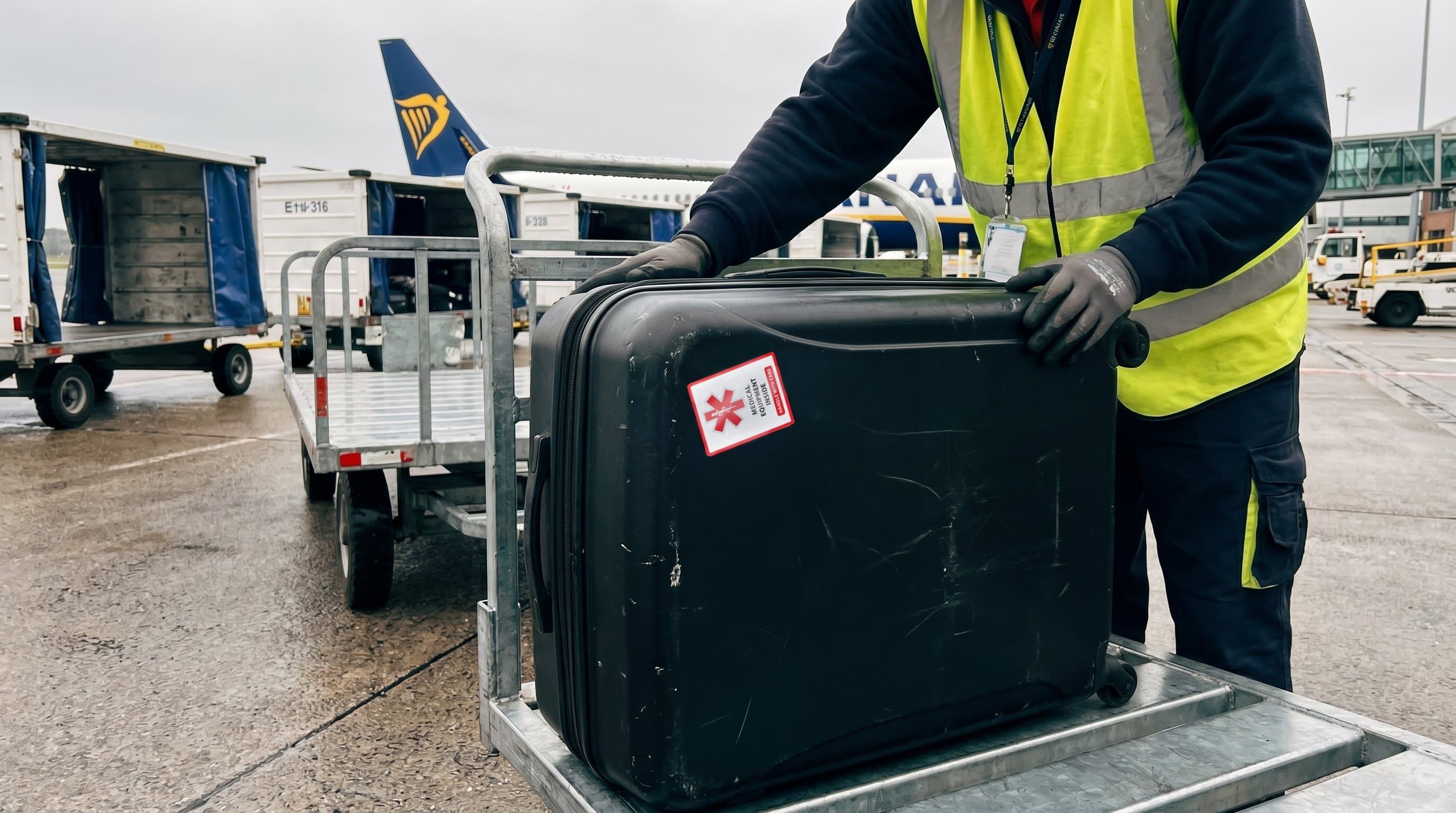
A Medical Equipment Luggage ID Tag on the CPAP bag helps here. Security staff see it, recognise what it is, and the process tends to go faster. It also matters if your bag is ever handled separately from you — at bag drop, at the gate, or at a hotel.
Setting Up at Your Destination
The first thing to figure out when you arrive is the outlet situation. Is there one next to the bed? Is it the right plug type? Is it occupied? A short extension lead (or power board) solves most outlet placement problems and is worth adding to your CPAP pouch if you've been caught by this before.
If you're running from a power bank, the outlet question becomes irrelevant for that night — you set up the machine, the mask and the power bank on the bedside table, and you're done. Charging the power bank for the next night can happen from any USB-C source while you're awake.
The Full Packing List
- CPAP machine (carry-on, accessible for security)
- Mask (in its own breathable bag or case)
- CPAP power pouch containing: cable, charger, adapter, wipes, spare filter, spare cushion, cable ties
- Power bank (carry-on only, accessible if asked)
- Medical Equipment Luggage ID Tag (on the CPAP bag)
- Physician's letter (international travel)
- Short extension lead (optional but useful)
After a trip or two, this becomes second nature — packing your CPAP takes no more thought than packing your shoes. The goal is to get to that point as quickly as possible, so the equipment stops feeling like a burden and starts feeling like just part of how you travel.
Tempted to check the machine instead of carrying it? Read why a CPAP should never go in checked luggage first.